There are so many things I love about living in community. Trying to find the smoked paprika is not one of them. Like the rest of us, I make dinner for everyone here just about once a week. And very often that dinner making contains at least one ingredient I knew was there last time I cooked that is now definitely missing. Sometimes the missing ingredient is easily found; I text the group chat and someone knows right where it is (and often brings it around). Sometimes, though, the ingredient is utterly gone. And then I rattle around the kitchen, slamming cupboards and rattling the pans in my frustration.
You see, we mostly share a central kitchen. There are other kitchens sprinkled around the place, and some folks spend some time cooking in those. Others of us (like me) tend to just use our collective kitchen for everything. Perhaps you can already see the smoked paprika problem. Is it in the central kitchen we share, but just moved to some innovative new place spices have never been stored before? Has it been moved to one of the other kitchens and forgotten? Has it been used up by someone who follows a different rule of kitchen etiquette? (My rule is: if it’s a staple or a spice and you finish it, replace it. Other people have the rule: If it’s a staple or a spice and you need it, buy it—which is why we have seven bottles of sesame oil. You see I like my rule better.)
Sometimes this frustration leads me to want to cook in my own kitchen with my own things. As I’m emptying the spice cupboard on to the counter and muttering about my lost paprika, I’m harkening back to the golden days when I had my very own house and only two of us used our kitchen, and life was simpler. I always knew where the smoked paprika was back then. I imagine a life in a smaller home, my own pots and pans, my own ingredients, my own everything. Bliss. And then I remember what it felt like to have all the responsibility and demand rest on Michael and me. I remember how hard it was to coordinate all the things about the house and the dogs with just the two of us. I remember the nights when I really wanted a friend to talk to and no one happened to be available (or awake). I remember being lonely more than I admitted even to myself.
I guess that’s why I find myself fantasizing about my own house so much less often than I feared I would. There are so many big and little joys of life in community. I love the practical things: there’s always someone to sign for a package or deal with the plumber or watch the dog while I’m away. And I love doing that for the others, feeding Meg and Tony’s cats or accomplishing something for one of my housemates. I love walking though the lounge after a late call to find friends drinking wine and having deep conversations by candlelight. I love the nights I don’t have a late call and I join them, or we play cards with 11 people and laugh until my stomach hurts. I love that there’s nearly always someone to have a coffee with if I’m feeling down about the world or champagne with if I’m celebratory. And in fact, I love making dinner once a week for twelve people instead of seven times a week for four.
But I really do hate the missing smoked paprika.
I wonder how much it is imagined issues like this that keep people from living together in community. I can’t count the number of times that people say, “Oh living communally sounds great, but I really couldn’t handle all that sharing!” What do we “handle” instead in our un-communal lives? Loneliness? Waste? Exhaustion of having to do it all ourselves? Is that really better?
I’m here to say that some things about living in community are hard. Don’t get me started on the insanely complex negotiations about whether the walls in our new living room should be white or off white. There’s nearly always someone to quibble about some opinion or another that someone else has. Life is filled with compromises.
But honestly, the compromises we seem to be making look to my eyes like the less important ones. Yes, we need to retain a sense of agency. We need to each have space that’s just ours as we negotiate our communal lives. Yes, some of the conversations circle and circle (and circle and circle and circle) and it feels like we get nowhere. Generally, though, we do get somewhere. And the amount of time spent on circling conversations about the door handles is delivered back tenfold with the other advantages (and is hilarious to tell stories about afterwards). And even the hardest conversations grow us. We learn more about each other. Our relationships deepen. The things that were frustrating before become understandable. Our own edges start to soften, to expand.
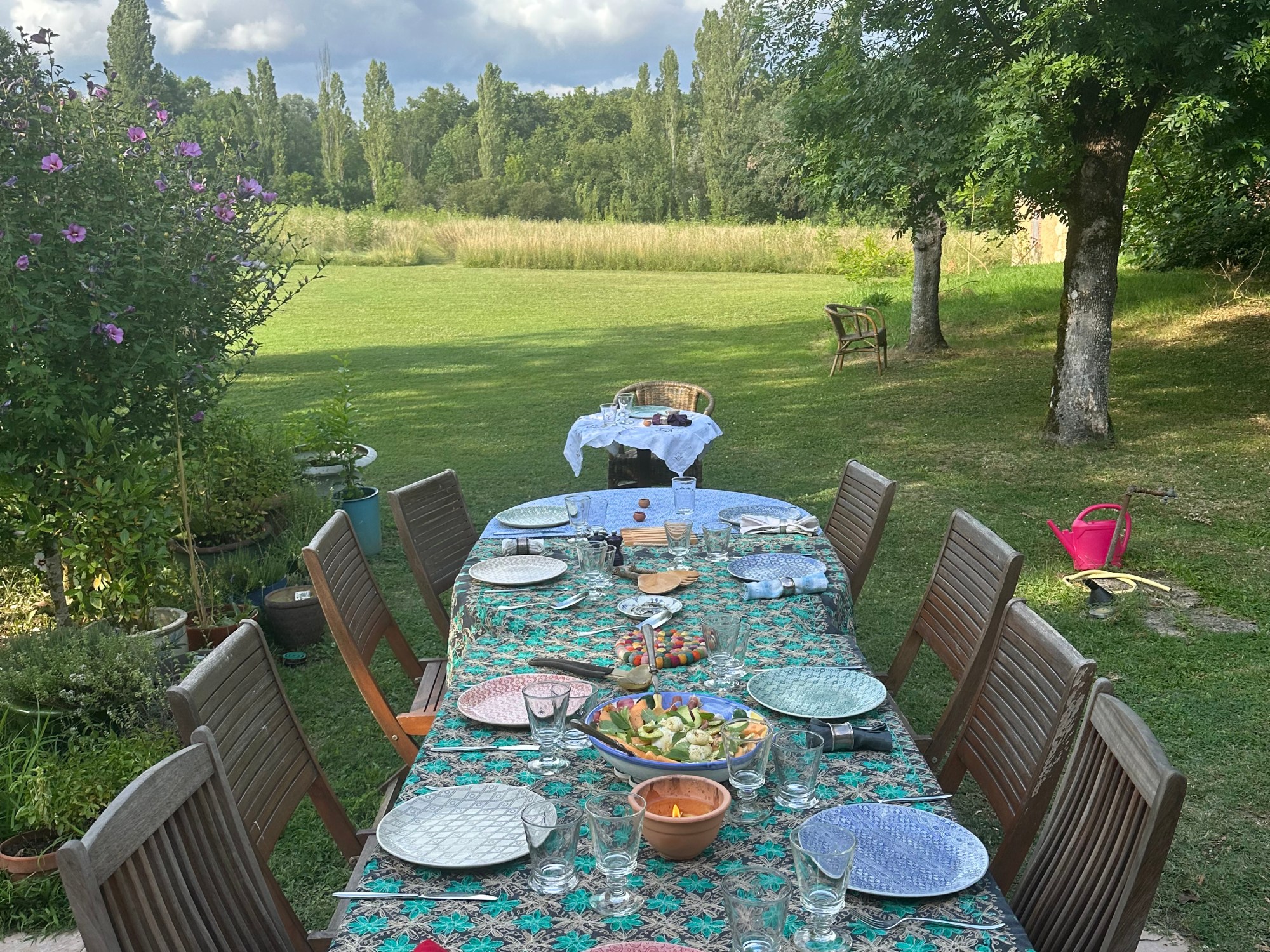
On Wednesday night thirteen of us sat around three dinner tables pushed together at the edge of our meadow. At the beginning of the meal we offered our gratitude, as we always do, for the day we’d had. For the conversations we’d had with each other, for the work we are lucky to do in the world. Jed told us he had fallen asleep while reading in a hammock and was woken by the snorting of a deer (who knew that deer snorted?). Everyone under 25 (and some people over 60) were grateful for swimming in the icy river. I had stayed in Keith’s office, writing, but I was grateful for a quiet day with the sound of distant laughter. Whether we were together or apart, working or playing, there was an abundance of gratitude. I looked at all these people, some of whom I know and love so much and some who were visiting whom I barely know at all. I ate the dinner deliciously made by Meg and whoever volunteered to help her. I saw connection, contentment, restoration on everyone’s face. I’ll give up the smoked paprika for that any day.
Ps The photo today isn’t of Wednesday night—I didn’t take a photo. It’s of another night, another table at the edge of our meadow. You can see that there’s one little table about two metres away from the big table. That was my table when I had Covid a few weeks ago. Even quarantining through Covid is nicer in community.

 25,000 dawns