People often ask about how we deal with disagreement here at the French Experiment. I’m always hearing, “My wife and I struggle to agree on anything around the house! It would kill me to have to work that out with 14 other people!”
This week, 14 of us looked at each other in our zoom boxes and tried to figure out how to disagree well enough to come to agreement. Wendy made a case for her favourite of the four options Keith had laid out in his paper. She asked whether anyone wanted to offer a counter proposal. Emotions were high and a lot of our collective money was at stake. A bad decision at this scale could be ruinous for us.
Recently, someone suggested we could simply “disagree and commit.” That phrase is used a lot around executive tables, but admittedly I have rarely seen it work in practice (although it works for some issues). In practice, what I’ve seen it do more often is to sharply increase the politicking before a meeting. Leaders know that they need to get enough folks aligned before they walk into the room, so that they have endless meetings before the meeting to try and coax people to their side. And sometimes it looks to me like it makes people simply more committed to their disagreement, and to the zero-sum game of winning the point. I’m tired just thinking about it.
So we don’t have the “disagree and commit” rule here in the French Experiment, and we don’t have it at Cultivating Leadership either. Which can make things kind of exhausting in another way.
Here at the French Experiment, we’ve been sitting on a house renovation project for some time now, arguing with the Bâtiments de France to try to get an elevator in our historic home. My mother is in a wheelchair and has never been upstairs in her own home. And even more importantly, any of us might someday need to be in a wheelchair, any of our guests might be in one. My accessibility sensibility is frustrated by our inaccessible upstairs.
The construction permit finally came, and the thing that would make a lift relatively straightforward was denied, and the thing that would make the lift difficult, more expensive, and uglier was approved.
Note how often this is true for you. Your team decides you want X (to build something/ make a new product/ open up a new market) and the initial feasibility study is favourable. You agree.
And then life happens, and everything gets more complicated and expensive. Now you wonder, is it really worth that money/ inconvenience/ risk to take those steps forward? You have taken some steps, sunk some money into this plan. Do you follow it to the end? We had agreed once upon a time, but with the change in circumstance, we didn’t agree anymore. Is this lack of commitment? Is this intelligent sensing into a new situation?
We agreed to decide at our next meeting. A small committee formed, not to canvass or politic, but to listen. They interviewed each of us, asking: “What is hard to say when we talk about this all together? What is most important to you when making this decision?”
And thus there we were in those zoom boxes; even those who live here together were each in our own space, on our own screen (hybrid teams feel more fair when everyone is in the same situation for a meeting).
We do not have a rule about the majority winning. We try for consensus. We do have a rule that no one person ever gets to veto, to hold up the whole collective. But our commitment is that no matter what, people deserve to feel heard. Even when we disagree, we can hear.
I believe that making decisions together is human work. And when humans make decisions together there is important possibility to be found in the human forms of disagreement. I often encourage the leaders I work with to lean into humanity when a decision doesn’t arise easily in a team. And so instead of talking about what we wanted to choose in this renovation, my housemates and I talked about what mattered to us. We talked about what was hardest to say. We reached to hold different perspectives.
I had gone into the meeting with one solution in mind, and as I heard my friends talk about their views, my own perspective shifted with the deeper understanding of what mattered. I disagreed, listened, and opened to a new idea. I changed my mind.
Together we opened up to a third way, not to create the lift but to create more space together on the ground floor—more space my mother could visit, perhaps another room a person in a wheelchair could use. The energy built as we saw the possibility together. At this time of great uncertainty, we decided to lean into optionality rather than sticking to an earlier decision.
I realized as we talked that this is what I’m describing when I talk to leaders about what teaming requires right now. When everything is changing faster than we’ve ever imagined, we need to be able to both hold our previous commitments and also release them in the face of a new context. We need to be able to work together, not only to disagree and commit, but to disagree to develop new ideas, to disagree to develop a sense of what this moment actually requires, without locking in on a single decision. We need to disagree to develop ourselves, too, to practice holding new perspectives with care, to grow more capacity in ourselves at a moment when the world demands more capacity each day.
I believe what we need are “brave teams.” I’ll be musing about this idea of “brave teams” in future essays, but I know at least this much: More than ever right now we need teams that are willing to say things that might not be popular. Teams that are willing to hear each other deeply. Teams that are able to develop new ideas from their disagreement.
Teaming in this way is not easy work. It takes deep and human relationships to be brave together, to make each other more brave. As we sat in our little zoom boxes at the French Experiment, wrestling with our renovation decision, we watched out for each other’s triggers. We listened carefully to what mattered most to one another. And thus we were able not to “disagree and commit,” but to disagree, to learn, and to change our minds.
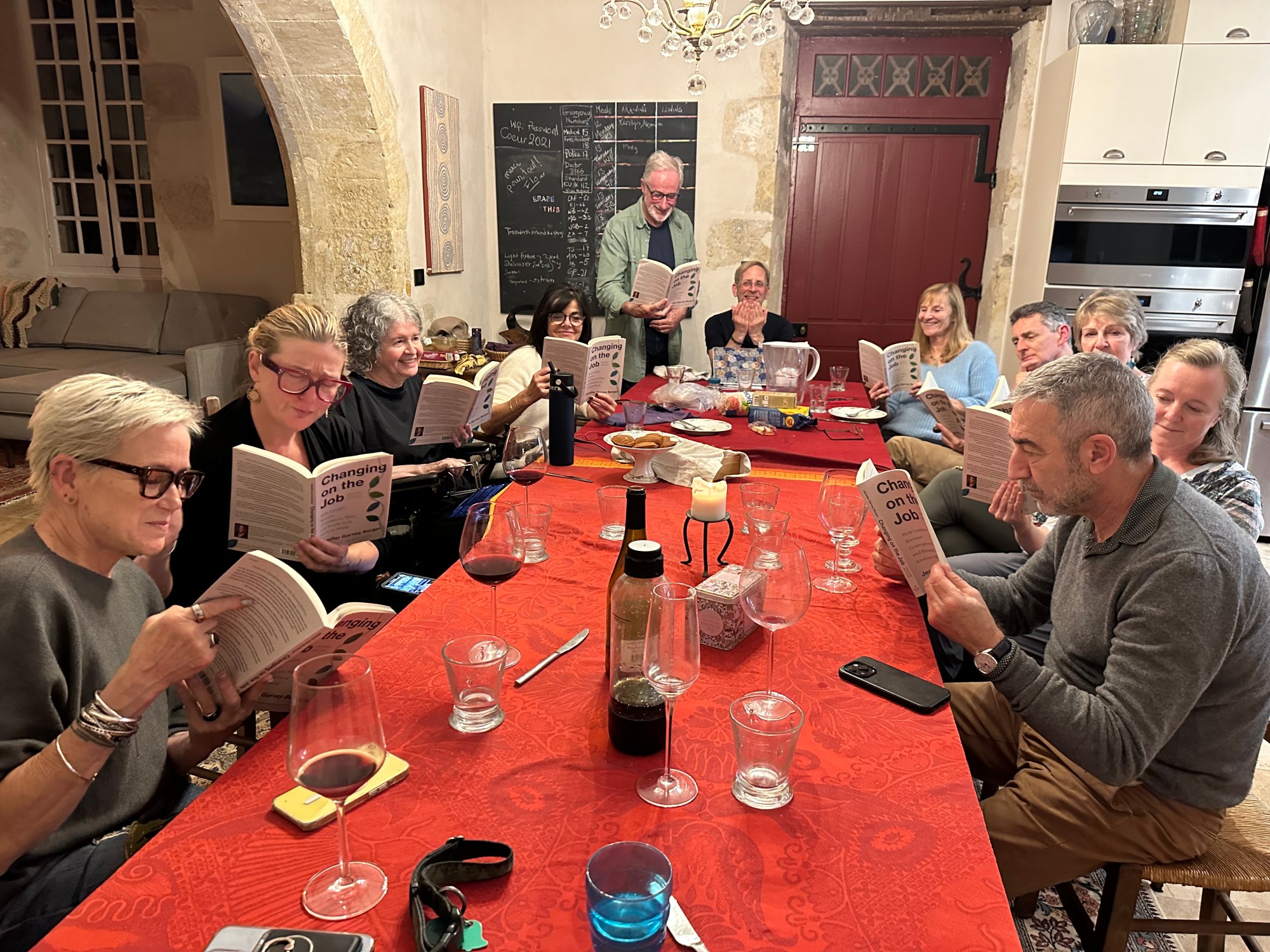
PS the photo today is a silly one–a bunch of our Brave Team “reading” my latest book. If you look carefully, you’ll see that Michael knows it by heart 🙂

 25,000 dawns